Large Scale Agrivoltaics
Starting in January 2026, the Large Scale Agrivoltaics project is a collaborative effort between the Southern Arava R&D and the University of Arizona. This research aims to optimize the dual use of land for renewable energy and agricultural production, addressing key questions about how agrivoltaics can improve crop resilience, enhance water use efficiency, and strengthen the financial sustainability of farms, particularly in arid and semi-arid regions. By combining expertise from Israel and the United States, the project seeks to create scalable models that support both energy generation and food production on large-scale farms.
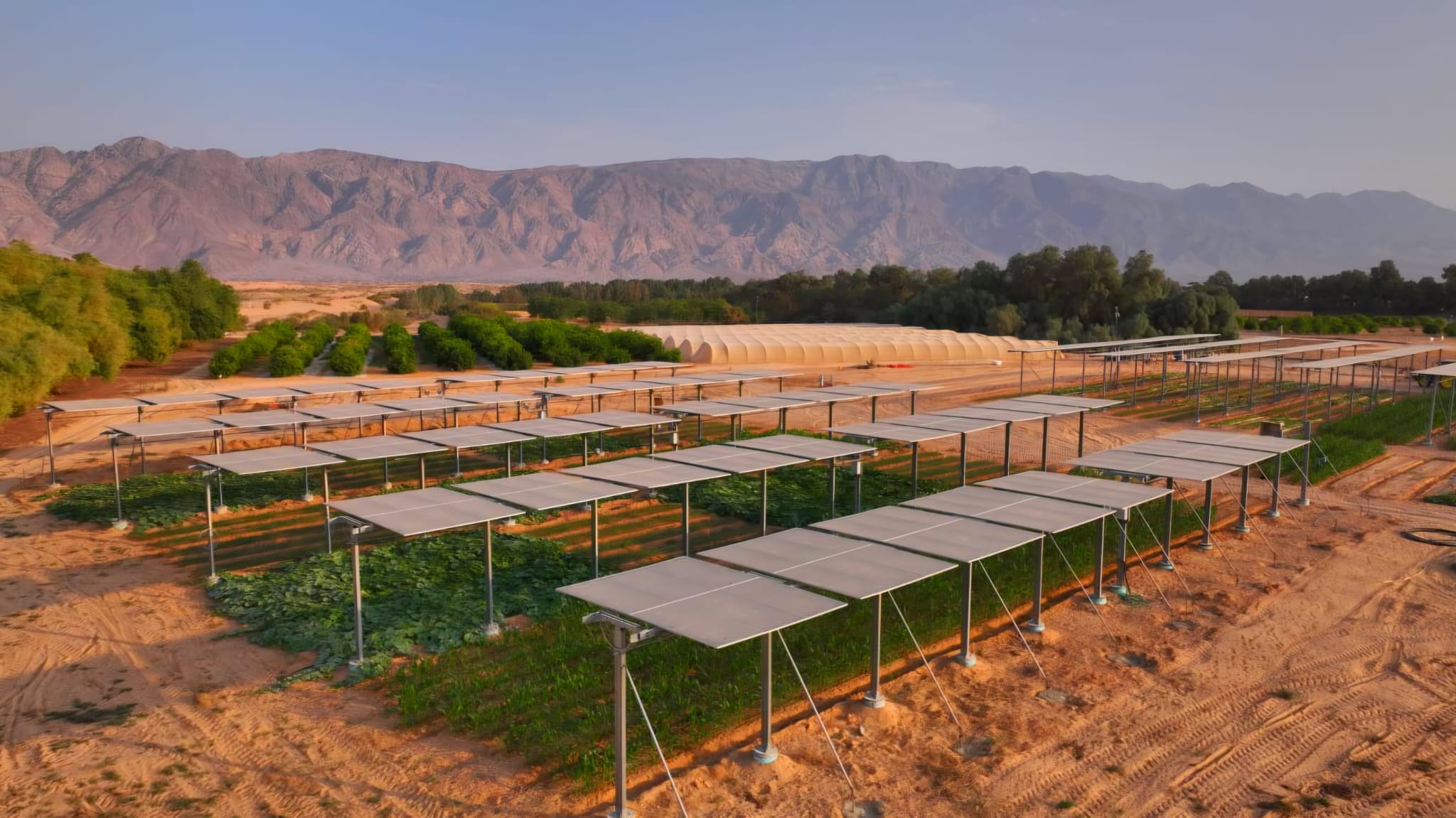
The project examines how agrivoltaics can reduce climate pressures and abiotic stress on crops while quantifying the trade-offs between optimizing for food production versus renewable energy generation through a holistic cost-benefit approach. Field experiments in the Southern Arava and Arizona will test multiple crop types under two photovoltaic (PV) tracking schedules—PV-centric versus agriculture-centric—leveraging the aridity gradient between the sites, from semi-arid to hyper-arid conditions.
By measuring microclimate impacts, upfront capital and operational costs, energy generation, and crop performance, the research will quantify the localized and system-wide effects of different agrivoltaic configurations. This work provides practical insights for farmers, enabling better planning for future panel installations, crop selection, and water use in the face of increasing aridity and temperature. On-site renewable energy can also power irrigation, processing, and other farm operations, reducing reliance on fossil fuels and lowering operational costs.
Large Scale Agrivoltaics builds on the success of smaller-scale implementations and positions agrivoltaics as a tool for sustainable land use in dryland regions. By demonstrating how dual land use can simultaneously support agriculture, renewable energy, and economic resilience, the project contributes to policy and practice for scaling agrivoltaics, helping farmers preserve agricultural productivity while meeting renewable energy targets.